

Kevin’s cancer journey came in two waves. The first was in 2018, which ended with stage two melanoma removal and a ‘cancer-free’ diagnosis. The second came eighteen months later. What started as routine back pain ended with a devastating diagnosis of stage four, incurable melanoma.
He recalls: “I started crying in the street with relief and after a year and a half I had to face the reality that, in terms of life expectancy, the odds were no longer in my favor.
“It felt like an alien experience – I didn’t fully register that the oncologist was talking to me, and it took me a while to understand the seriousness of the situation.”
After being recommended a course of immunotherapy, which he was told could extend his life, there was still no guarantee how long it might last. As Kevin shared his diagnosis with his loved ones, shock spread throughout his family.
His thoughts were dominated not only by his own health, but even more so, by concerns about how he would cope if his treatment was unsuccessful.
“My biggest fear was focusing on my family,” he explains. “My hope was that I would be able to be there for at least a few more years, a few more Christmases – that became a big focus for me.”
Kevin Donaghy, Cancer and Stories of Hope
As Kevin worked on ‘Stories of Cancer and Hope’, he realized that hope is everywhere. As he held it together for his family, others discovered it in their own ways — through small victories, meaningful relationships, and the courage to keep sharing their journeys.
Kevin admits that he didn’t consciously think much about hope at first, but as he compiled each story he realized how deeply it matters to people.
Among the many contributions, a story of an oncology nurse deeply influenced him.
“He said something very profound,” Kevin recalls. “She said, ‘Hope is constant, hope is always there. But sometimes it changes.’
“Hopes change throughout your journey. In my case, before my diagnosis, I hoped it wasn’t cancer. Later, I hoped it could be treated, and then I hoped my life could be extended. These are the same hopes you can share with your family, too.”
finding hope in an unexpected encounter
Kevin shares another story of a woman named Debbie who was diagnosed with breast cancer shortly after returning from her honeymoon. Terrified, she walked into the treatment room at her local hospital, and found herself sitting across from a woman whose fingers were covered with diamond rings.
As Debbie stared, the woman looked up and asked if she wanted to hear the story behind them.
“He told Debbie that several years ago, he was diagnosed with cancer, and the prognosis wasn’t great,” says Kevin. “Her husband had promised that every year that she lived, he would buy her a diamond ring.
“She had 22 diamond rings on her fingers. That unexpected meeting gave Debbie a lot of hope as she began her journey.”
Receiving a cancer diagnosis can feel incredibly isolating. While cancer affects one in two of us in our lifetime, when you are told you have this cancer it can feel like it is only happening to you. Kevin Donaghy is keen to convey in his book that whether you have been diagnosed, or you are supporting someone who has, you are definitely not alone.
“For most people I knew in the ’70s and ’80s, cancer was whispered about rather than discussed openly,” says Kevin. “It was almost seen as a death sentence. But things have moved on since then.”
He explains that by talking openly about cancer, people can get rid of this feeling of isolation. Sharing stories not only helps others feel less alone, but also provides a supportive space for people to connect and heal.
“I felt blessed that people wanted to share their stories and that I could support them during this period of isolation,” says Kevin. “Sometimes they open up about things they haven’t shared with anyone else.”
Making space for the stories that men keep hidden
One thing Kevin noticed was that people who felt they had to be the “bearer of hope” for their family – often suppressing their emotions to appear strong – found that sharing their stories with someone who had gone through a similar experience could be incredibly cathartic.
This was especially true of the many male contributors to his book.
“If you’re a man, you may often feel a responsibility to put on a brave face when things don’t seem to be OK,” he explains. “What I found among some of the men I interviewed was that they opened up about things they had never told anyone before – but they still wanted to share their experiences with the wider community.”
Some of the articles in ‘Stories of Cancer and Hope’ describe cancer symptoms that you may never find online or in a leaflet. They come from real, lived experience, showing how symptoms can often manifest in unexpected ways – things that don’t always translate through static text or a purely clinical perspective.
This does not mean that you should not rely on reliable sources for information about health conditions or diseases. But hearing about the symptoms firsthand is very different from simply looking up a list of signs on Google.
“There are over 200 different types of cancer, with some fantastic campaigns to help raise awareness of the warning signs,” says Kevin. “But we also have to be advocates for our own health. You can spend your whole life Googling and self-diagnosing, but each of us has a responsibility to reach out for answers if we know something isn’t right.”
He further explains that, in his own experience, four medical professionals told him that his melanoma did not appear cancerous. Sharing stories and talking openly about different diagnoses – and even potential misdiagnoses – has real power in encouraging people to find and secure the right care when they need it.
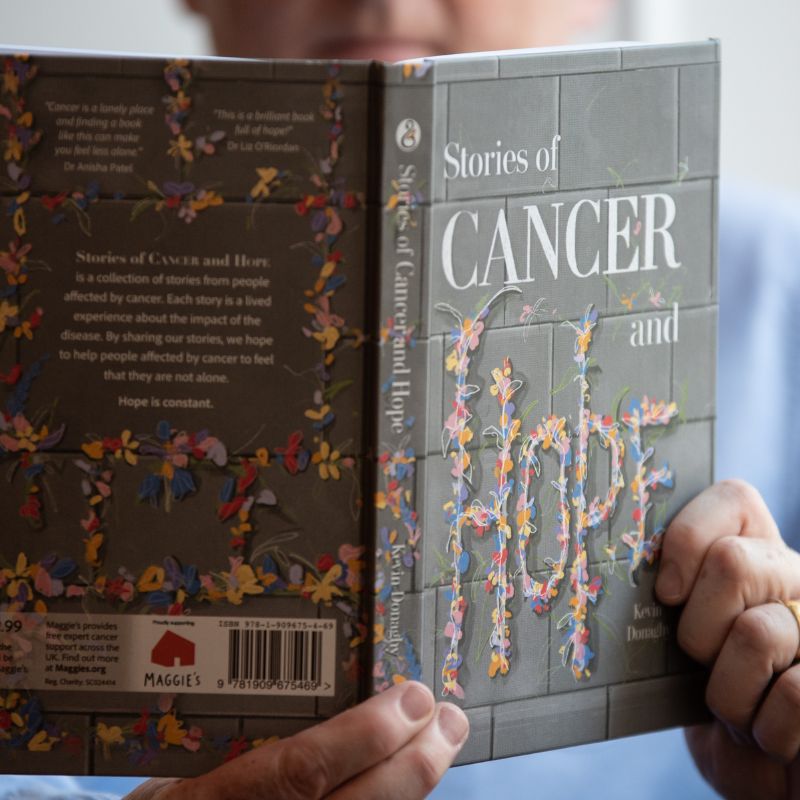
Maggie’s is a charity that provides free practical and emotional support to anyone suffering from or affected by cancer. Maggie’s first center was built in Edinburgh, which is where Kevin first learned about their incredible work.
Maggi now has 27 centers across the UKUsually located next to major hospitals or cancer departments. They are open to anyone who feels they need help coping with the effects of cancer. All royalties from ‘Stories of Cancer and Hope’ are donated to Maggie’s to support her ongoing work.
Kevin explains that his relationship with Maggie developed some time after his diagnosis.
He says, “It took me a while to recover from my treatment before I could properly focus on putting my idea for the book into practice.” “I just went to Maggie’s in Edinburgh with nothing to show, explained my idea for the book, and within 24 hours they came back and said They would love to have copies of ‘Stories of Cancer and Hope’ In every centre.”
Since then, Kevin has built a strong relationship with Maggie, strengthened by the presence of his book in every support hub. They hope this will help those who access their services and help people who don’t know what to say to someone with cancer find the courage to reach out, and give them a personal insight into what it’s like to live with this disease. Likewise, he hopes the book will help health professionals see the person behind the diagnosis.
“Maggie offers a lot of different services,” says Kevin. “They run classes, bring people to alternative treatments, and advise on financial aid. At each centre, there are pre-oncology nurses to provide support.
“You just walk in. Someone will come up to you, give you a cup of tea or coffee, and try to find out why you came through the door.”
When the treatment ends but the fight doesn’t
When your cancer treatment is over, the story doesn’t end there. After this, taking care of your mental health is as important as the physical challenge. This is a difficult time – especially as your support system shrinks as you begin to deal with the trauma you’ve endured.
Kevin explains that when you are in the system, going through treatment, there are countless people there to guide and support you through the procedures and side effects. But once the cancer is removed, or you’re in remission and it’s under control, that network may disappear.
“This can be painful for many people,” he says. “Your safety net has suddenly ended.”
He shares a special story from his book, about a contributor named Keith who was treated for non-Hodgkin’s lymphoma.
“She felt fine throughout the treatment,” explains Kevin. “But the moment it ended, that’s when the real impact hit. She had to go to counseling to deal with being taken out of the system and suddenly being completely responsible for everything that happened.”
As Kevin collected stories from people who shared similar experiences with cancer, he began to form friendships with them. This helped them feel less isolated in their own diagnosis, even though they realized that some of these friendships would inevitably be lost along the way.
Kevin says, “It would have been very easy to have 39 stories in the book where everyone lived happily ever after.” “But that’s not the reality of cancer. Most of the people who contributed are still with us and living wonderful lives.”
“Some of them will die in the future – not necessarily from cancer – but we knew we had to include their stories. We knew we would lose people as time went on.”
Kevin says he keeps in close touch with all the contributors to ‘Stories of Cancer and Hope’. For those who are no longer with us, he ensures that their families have the opportunity to continue their story.
“The family of whoever has left us always has the option to add to their story,” he explains. “My name may be at the front, but this book is as much theirs as it is mine. It’s so important for their voices to be heard. It’s hard when we lose a contributor, but it’s important to keep their story alive – hopefully for years to come.”
Why does Anna’s story affect us?
One contributor who holds special importance for Kevin is Anna. Their story is depicted at the beginning of the book by an artist’s impression of Anna playing the piano – painted by Kevin’s daughter, Katherine.
“Anna was the only storyteller who didn’t get a chance to see the book produced,” explains Kevin. “Unfortunately, she passed away a few months ago. She was a professor of music and a brilliant musician.
“At her funeral, they played a ten-second video of Anna playing the piano. It was taken by her husband David during a holiday in Denmark while she was suffering from cancer. In the video, she is playing ‘When I’m Sixty-Four’ by the Beatles. The strange thing is that Anna was 64 when she died.”
Whether you are living with cancer or supporting someone who is, you are never walking this path alone. In addition to the vital support of charities like Magee, strength can also be found in the shared experiences of others.
This is the center of Kevin’s mission.
Although his sense of hope has grown through every stage of his diagnosis, his latest aim is to provide that hope to you. Through the pages of ‘Stories of Cancer and Hope’, they aim to remind every reader that although their journey is unique, they belong to a community that truly understands.
“It takes some time to process your diagnosis,” he says. “Hopefully, by reading other people’s stories, you’ll feel encouraged to talk to others affected by cancer – or even to share your story.
“Remember, you’re not alone. Whatever you’re going through, whatever your fears or hopes are, other people are going through something similar. Once you make that connection – whether it’s through reading a story or meeting someone in person – then it helps. It absolutely helps.”
