
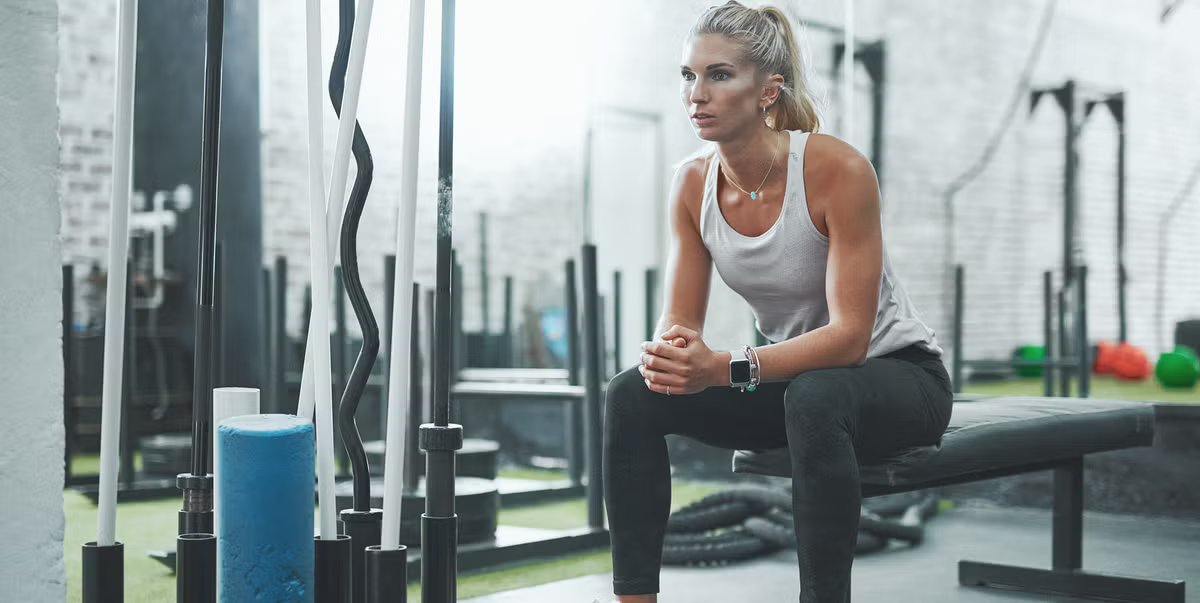
This is why rest periods are programmed according to the quality workout – And it’s not just to lower your heart rate. according to PT Andy VincentThere are four major reasons for resting between sets: to restore energy systems (primarily phosphocreatine and ATP), to reduce fatigue mechanisms, to restore motor neuron excitation, and to improve psychological preparation for the next effort.
If you feel extremely tired after set two, there’s a good chance you’re not resting long enough.
What happens to the body when you rest between sets?
energy is replenished
Vincent explains, ‘During high-intensity contractions, your muscles use ATP – adenosine triphosphate – specifically to promote contraction by releasing a phosphate group, releasing ATP as ADP (adenosine diphosphate).’
Rest allows phosphocreatine resynthesis, meaning energy is available for subsequent sets. ‘About 70% will be restored in the first 30 to 60 seconds,’ says Vincent. ‘About 90% is restored after 90 seconds to two minutes, and full restoration may take three to five minutes.’
This is the primary cause in the remaining cases of maximum strength work or sets leading to failure.
fatigue mechanisms are reduced
‘Metabolites are created in the muscles – inorganic phosphate from ATP breakdown and hydrogen ions from glycogen use,’ says Vincent. This accumulation contributes to muscle fatigue and poor performance.
Rest allows those metabolites to be cleared and redistributed, while helping to restore intracellular pH levels.
motor neuron excitation is restored
‘When your muscles contract, a lot of motor units are activated,’ explains Vincent. ‘After a hard set, motor unit firing is reduced.’
This is especially true after near-maximal or failure-level efforts. Adequate rest restores motor neuron excitation, helping you produce higher quality reps in subsequent sets and reducing the risk of injury.
you feel psychologically prepared
‘If you’ve done your maximum sets, the rest period allows you to refocus,’ says Vincent. ‘The perception of effort is very high immediately after hard work, but it decreases over time. People usually feel more confident after resting for a while.’
How much rest do you really need?
The easiest way to determine your rest period is to match it to the effort set – specifically, how close you were to failure.
‘There is often a perception that shorter rest periods are more efficient or burn more calories,’ says Vincent. ‘But adequate rest enables you to get the highest quality training session.’
Low Reps (1-5)
‘If you’re working in a low rep range and doing hard sets, that’s high-intensity, extremely fatiguing work,’ says Vincent. This style of training may require up to five minutes of rest for maximum ATP regeneration and complete psychological reset.
Medium Reps (6-10)
If sets are taken at or near failure, rest should still be adequate. Vincent recommends a minimum of 90 seconds, a maximum of three minutes.
The complexity of the task also matters. ‘Bicep curls are a different exercise. A back squat is one mixtureMulti-joint movement requires more torso and hip stability, so more rest will be required,’ he says.
High Rep (12+)
high-rep training Creates excess metabolic stress and acidosis. ‘The body has to deal with more ionic fatigue but it’s actually easier to recover from,’ says Vincent. A rest period of 60 to 90 seconds is usually sufficient.
How do you know if you are getting enough rest?
After you’ve rested, you should feel calm and ready to perform.
‘A decline in performance is the biggest indicator that your rest period was too short,’ says Vincent. If you complete almost max sets, rest, and then notice a significant decrease in reps on the next set, you may need more time.
On the other hand, resting for too long can lead to loss of focus. ‘You may lack composure because your mind has wandered,’ says Vincent.
But if you’re unsure, err on the side of more rest rather than less.
‘A slightly longer rest period is usually better for all the results people care about – build muscle And rising force,’ says Vincent. ‘Overall, quality is better than quantity.’
Abby Henderson is an acting nutrition writer covering health, fitness, women’s sports, and lifestyle for Women’s Health and Men’s Health. Before settling in the British seaside town, she spent a few years living in Canada, where she contributed to publications like Best Health, Foodism, and Canadian Living and found that, in fact, she’s a little outdoorsy. With a desire to help make health care, exercise, and sports more accessible to women, she writes about everything from the realities of seeking medical help as a woman to being a female athlete fighting for equality. She has a personal trainer qualification, a few medals in her short time in competitive Irish dancing and an Arsenal Women season ticket. When she’s not working in front of a screen, she loves weightlifting, going on walks and stopping for small treats (matcha and pastries) and trying new recipes (which are almost always pasta-based).
